
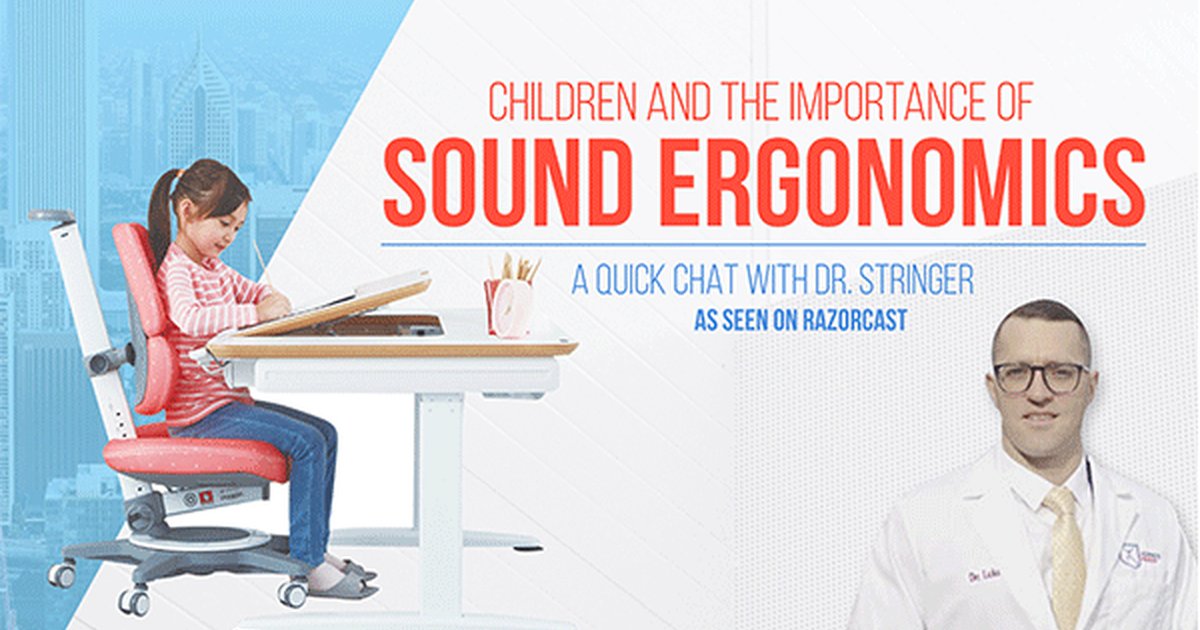
How your child sits at a desk, holds a tablet, and carries a backpack shapes the spine they'll live in as an adult. Kids are adaptable — that's the good news and the bad news. If they grow around poor posture, it's much harder to undo later. This post walks through what sound ergonomics looks like at every stage, from tummy time to teenage screen time, and the small habits that protect your child's spine, nervous system, and focus.
What ergonomics really means for kids
Ergonomics is just how you sit, stand, and position your body when you're working, learning, or playing. For an adult, that's the desk and the cubicle. For a child, it's the classroom chair, the homework setup, and the couch where they curl over a tablet.
We talk about this constantly with parents in our office, because the research keeps reinforcing the same point: a healthy spine drives healthy function. When a child's posture is off — especially forward head posture from screens — it pulls the upper neck out of alignment and puts tension on the nerves where neurological activity is densest. That's not just a pain issue. It's increasingly linked to the sensory and attention challenges (ADD, ADHD-type symptoms, sensory processing issues) we're seeing more of in kids who live on devices.
Babies and toddlers: build the foundation
Prioritize tummy time. When babies lie on their stomachs and lift their heads, they engage the muscles along the back of the body and start building the curve in the neck. We call that curve the curve of life — it dictates how load travels through the joints and nerves. Plenty of tummy time sets the foundation for a healthy spine.
Don't skip crawling. Some babies go straight from tummy time to walking. The crawl phase develops the cross-crawl pattern — a neural pathway that gets both sides of the brain working together. If your baby isn't naturally interested in crawling, encourage it. It's a reflex worth developing.
Watch the screen angle on toddlers. If your two-year-old is watching a show or holding an iPad, keep four fingers of space between their chin and chest. Chin-to-chest plus the weight of the head plus gravity is the exact combination that drags the neck curve out of alignment.
School-age kids: motion, setup, and the four-finger rule
Classroom chairs are cute. Ergonomically, they're a mess. And no child — or adult — should sit for six to eight hours straight. Motion is lotion.
A good rule of thumb: sit for 20 to 30 minutes, then stand for 30 to 40 minutes. Repeat. Schools rarely allow this, so make it possible at home. A sit/stand desk for homework is one of the best investments you can make in your child's posture.
For the workstation itself:
- Chair supports the low back. Feet flat, hips and knees roughly at 90 degrees.
- Screen at eye level. Not tilted up, not tilted down. Whatever they're looking at — TV, laptop, tablet — should be straight ahead.
- Four fingers between chin and chest. This keeps the head out of flexion and preserves the neck curve.
- Shoulders back and relaxed, with a gentle sense of the shoulder blades pinching behind them.
It's not a coincidence that learning and attention issues have climbed alongside screen time. The further forward the head travels, the more gravity loads the upper neck — and that's the part of the spine with the densest neurological activity.
Worried about your child's posture or screen-time habits? Bring them in for a $49 new patient exam and X-rays at Advanced Health Chiropractic in the South Loop. We'll assess their neck curve, posture, and spinal alignment and give you a clear plan. Book online at /schedule or call (312) 987-4878.
Handheld devices and the forward-head problem
Researcher and chiropractor Dr. Deed Harrison — who developed the Chiropractic BioPhysics methods we use in our office — published a study evaluating the neck curve against the kind of sensory and neuromotor performance tests used with elite athletes and fighter pilots: reaction time, information processing, balance.
The finding: the further forward the head and the flatter the neck curve, the worse the performance. Kids and adults with hunched, forward-head posture tested noticeably worse than those with healthy curves.
The takeaways for handheld devices:
- Limit total time. Beyond posture, there's blue light and other sensory inputs affecting physiology.
- Eye level, not lap level. Hold the device up. If they have to look down, four fingers off the chest.
- Take movement breaks. Same sit-stand rhythm as schoolwork.
Backpacks: weight, straps, and shape
Backpacks are one of the most overlooked ergonomic factors in a child's day. A few simple rules:
- Cap the weight at 15-20% of body weight. A 100-pound child should carry no more than 15 to 20 pounds. (Some guidelines go up to 25-30%, but lower is better.)
- Two straps, always. One-strap carry twists the spine and loads one shoulder.
- Snug to the spine. Tighten the straps so the pack sits high and close to the back, not slumping at the hips.
- Consider the shape. Wider, flatter packs (more surface area against the back) distribute load better than tall, narrow ones that pull the shoulders back and down.
Look at your child's backpack tomorrow morning. What's in it, how heavy it is, and how they're wearing it — small adjustments here go a long way.
The bottom line
Kids adapt fast. That's why building good ergonomic habits early matters so much: tummy time as a baby, the four-finger rule on screens, a sit/stand option at home, and a backpack that fits. These aren't fussy details — they're the inputs that shape spinal development and nervous system function for the next 70 years.
If you'd like us to assess your child's posture and spine, we see pediatric patients regularly at our South Loop office. Book a new patient visit at /new-patients or call (312) 987-4878.
Have a similar concern?
The fastest way to get answers about your specific situation is a New Patient Exam.
Schedule your new patient exam