
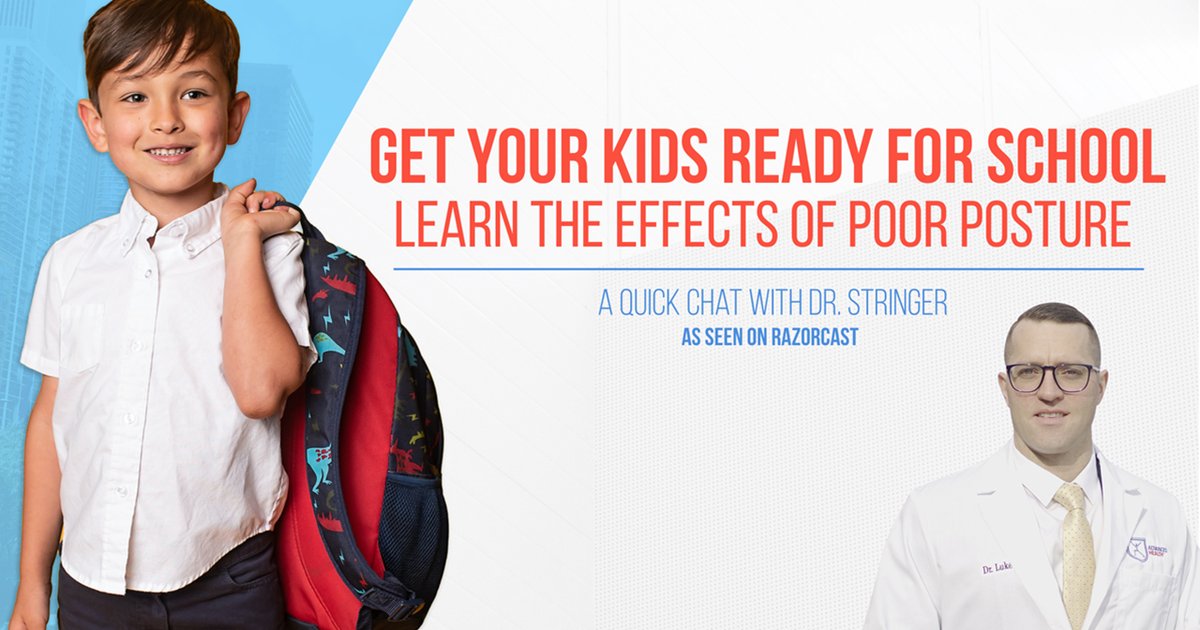
Poor posture in kids isn't just a cosmetic issue — it shapes how their spine, nervous system, and even hormones develop. With school starting up, here's what to watch for, how to fix the most common posture habits we see in our South Loop office, and when it's worth bringing your child in to a chiropractor.
Why posture matters for growing kids
Posture is the window to your child's spine and overall health. When the spine sits in a chronically poor position — head forward, shoulders rounded, low back collapsed — the body interprets it as stress. That low-grade stress can show up as headaches, neck pain, and low back pain, but it doesn't stop there.
Chronic postural stress shifts the nervous system into a sympathetic (fight-or-flight) state. That state was designed for short bursts — getting rear-ended, eyes wide, neck braced — not for an eight-hour school day. Sustained sympathetic tone releases cortisol, and cortisol blocks insulin reception, which spikes blood sugar and disrupts hormone regulation across the board.
In kids, that often shows up less as pain and more as dysfunction: poor sleep, low energy, mood swings, trouble concentrating in class, and sensory issues. Good posture gives your child's body the best chance to grow, focus, and develop normally.
The negative effects of chronic poor posture at a young age
From the side, good posture means the ear stacks directly over the shoulder. Spend the day looking down at a tablet and that head drifts forward, dragging tension into the muscles at the base of the neck and the upper back. That's the setup for tension headaches, neck pain, and upper back pain.
The average adult head weighs 10 to 12 pounds. A child's head is roughly half that — but add gravity and time, and a five- or six-pound head pulling forward all day gradually shifts the cervical spine out of alignment. The normal curve in the neck flattens, the muscles overwork, and you get what's commonly called tech neck.
Bad posture habits parents should watch for
The single biggest one is flexion — closing the angle between the chin and the chest. Looking down at a tablet, a phone, a book, or a low workstation all force the head into flexion.
When I'm out running errands with my wife (also a chiropractor), it's striking how many two-year-olds we see in strollers with their chin planted on their chest, just staring down at their lap. Over months and years, that's the position that builds tech neck.
The four-finger test
Here's a simple check you can do with your child right now:
- Place your pinky in the notch between the collarbones, at the top of the sternum.
- Stack four fingers up from there toward the chin.
- When looking down at a screen or book, the chin should not come closer to the chest than those four fingers.
If the chin crosses that line, the head is in flexion and the cervical spine is loading. Raise the device, raise the book, or take a break.
What to look for in a school backpack
A poorly loaded backpack is one of the fastest ways to wreck a kid's posture. A few rules of thumb:
- Total weight should be no more than 20% of your child's body weight. This is the single most important factor.
- Two straps, worn tight to the shoulders. Single-strap or cross-body carry loads one side of the body and twists the spine.
- Use the chest strap if the backpack has one — it keeps the load close to the body.
- Straps should be snug, not dangling low. A backpack that hangs off the low back pulls the child backward, which forces the upper back and neck to shift forward to counterbalance. The spine works in kinematic chains: shift one segment one way and another segment has to shift the opposite way to keep you upright.
We partner with Bixbee, a kids' brand designed around ergonomics — their packs are oriented landscape rather than portrait, so the load distributes more evenly across the back. Any well-fitted backpack will work, though, as long as you're following the rules above.
Worried your child's posture is already heading the wrong direction? Get a $49 new patient exam and X-rays at Advanced Health Chiropractic in the South Loop — we'll show you exactly where the spine is shifting and what to do about it. Book online at /schedule or call (312) 987-4878.
Helping your child build better posture before the school year
If your kiddo already has visible postural shifts, or if they're dealing with headaches, neck pain, low back pain, or trouble concentrating at school, get them evaluated by a chiropractor. A chiropractor is a spinal specialist — we can identify where and how the spine has shifted and build a treatment plan around those specific shifts.
Outside of care, a few habits go a long way:
Move often — motion is lotion
The body isn't built to hold a single posture for hours. For older kids and teens doing homework, a sit-stand desk is ideal. A good rule of thumb is 20 minutes sitting, 40 minutes standing, with short posture breaks in between to wake up the deep stabilizing muscles in the neck and between the shoulder blades.
Train the posture muscles
The muscles that hold us upright get weak and lazy when we're sedentary. A handful of targeted exercises a few times a week — engaging the deep neck flexors and the muscles between the shoulder blades — makes a real difference.
Practice good ergonomics at the desk
When your child sits down to do homework:
- Sit close to the desk, not leaning forward
- 90-degree bend at the knees, feet flat on the floor
- Slight recline in the chair, shoulders back
- 90-degree bend at the elbows, wrists neutral (not pointed up or down)
- Screen about three feet away, roughly eye level (a five-degree downward tilt is fine)
- Four fingers between chin and chest when looking down
These are simple changes, and they're surprisingly effective when you actually stick with them.
Get your child checked before the school year starts
Postural problems are easier to correct in kids than in adults — the spine is still developing, and small changes now prevent bigger ones later. If you'd like us to take a look, schedule a new patient visit at /new-patients or call (312) 987-4878. We see kids of all ages at our South Loop office.
Have a similar concern?
The fastest way to get answers about your specific situation is a New Patient Exam.
Schedule your new patient exam