
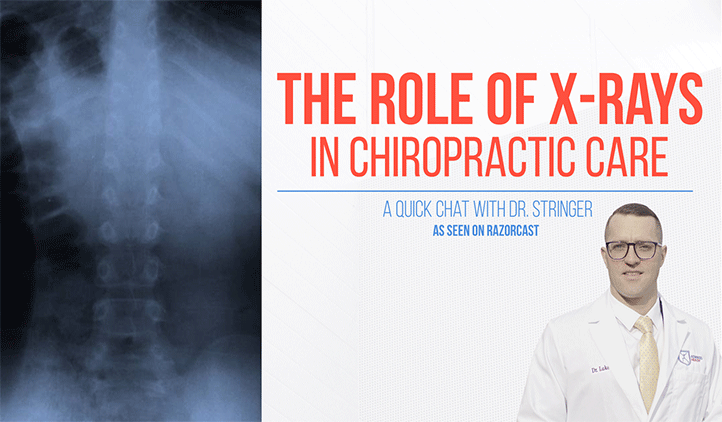
We use X-rays in chiropractic care because to see is to know. If we're going to work with your spine and nervous system, we want to see exactly what's going on in there first — which is why nearly every new patient at our South Loop office gets imaging before treatment begins. Think of it like building a house: you don't build without blueprints, otherwise you're guessing. Here's why chiropractors take X-rays, what we look for on your films, and how X-ray analysis shapes your treatment plan from day one.
Why chiropractors take X-rays
X-rays give us objective information we can't get any other way. They help us do three things:
- Evaluate the health of your spine — bone quality, disc height, joint spacing, and any degenerative changes that would alter how we treat you.
- Measure the shape of your spine — whether your curves are where they should be, and whether any segments have shifted forward, sideways, or rotated.
- Screen for problems that need a different kind of care. Occasionally imaging reveals something a patient had no idea was there — signs of a possible growth, infection, or fracture. Finding that early means we can refer you to the right specialist promptly instead of treating over the top of it.
Knowing the shape of your spine also tells us how to adjust it. If you've lost the curve in your neck or a segment has shifted, we want to know before we ever put hands on you — because that changes what we do, where we do it, and how we set up any traction or corrective work.
The exam always comes first
We don't X-ray everyone by default. Before any imaging, you get a detailed consultation and a thorough examination: orthopedic testing, a neurological exam to check whether the nerves in your spine are doing their job, range-of-motion testing, and a functional evaluation of how your joints actually move. That exam dictates whether X-rays are needed — and in most cases at our clinic, they are, because the exam raises questions only imaging can answer.
What a chiropractic X-ray series looks like
There are many specific films for specific situations, but a typical series is straightforward. For the lower back, that's a front-to-back view capturing the pelvis, sacrum, and lumbar spine, plus a lateral view taken from the side. For the neck, the same idea applies.
If you've had significant trauma — a car accident, a hard fall — we may add flexion and extension views, where you bend forward and backward during the image. Joints that shift excessively on those movement films can indicate ligament damage, and that's something we absolutely want to know about before treating you.
What we look for in X-ray analysis
When we sit down with your images, we're checking joint alignment, spinal alignment, bone health, and disc health. Is there narrowing where a nerve exits the spine? Any signs of degeneration, pathology, or soft tissue damage? And it's not only the spine — knees, shoulders, wrists, and ankles can all be imaged when the exam points there.
One example of why this matters: a younger, active patient came in with fairly mild symptoms — his main complaint was headaches. His films showed his spine had shifted roughly an inch to the left, an inch forward, with a reversed neck curve, and the top bone in his neck was sitting up against the base of his skull. None of that was obvious from the outside. If we're going to adjust that area, we need to know exactly what we're adjusting — and now we did.
How X-ray analysis shapes your treatment plan
This is where the imaging earns its keep. Your films tell us whether your plan should include adjustments, spinal traction, physical therapy, soft tissue work, or a combination — and exactly how to set each piece up.
We practice Chiropractic BioPhysics (CBP), a structural approach that uses your X-ray measurements to guide corrective care. Because we can measure the shape of your spine precisely, we can prescribe traction designed to move it back toward normal alignment — and then re-image later to verify whether the structure actually changed. That objective, measurable approach is what separates a customized plan from a one-size-fits-all adjustment schedule.
Want to see what your spine actually looks like? New patients get an exam and X-rays for $49 at Advanced Health in the South Loop. Book online or call (312) 987-4878 — we'll walk you through your images and what they mean.
Who reads your X-rays
We take your X-rays in-office and read them ourselves — in Illinois, chiropractors are licensed to take and interpret X-rays, backed by extensive radiology coursework and board examinations. Then we go a step further: every film is also sent to a radiologist for a second set of expert eyes. Not every clinic does that; we do it to be thorough. Some chiropractors even complete additional years of training to become a DACBR — the chiropractic equivalent of a radiologist, clinically trained to read X-rays, MRIs, and CTs.
Before-and-after X-rays: proof, not promises
For patients in corrective care, we typically image at the start of the plan and again at the end. Comparing those films side by side shows whether your spinal structure genuinely changed — objective evidence, not just "I feel better." Many patients find that comparison the most motivating moment of their care.
X-rays help us put together the puzzle of what's driving your pain and choose the treatment approach that fits your spine — not somebody else's. If you've been dealing with back pain, neck pain, or headaches and nobody has ever actually looked at your spine, that's a good place to start. Schedule your $49 new patient exam and X-rays, or learn more about our approach on our new patients page.
Have a similar concern?
The fastest way to get answers about your specific situation is a New Patient Exam.
Schedule your new patient exam