
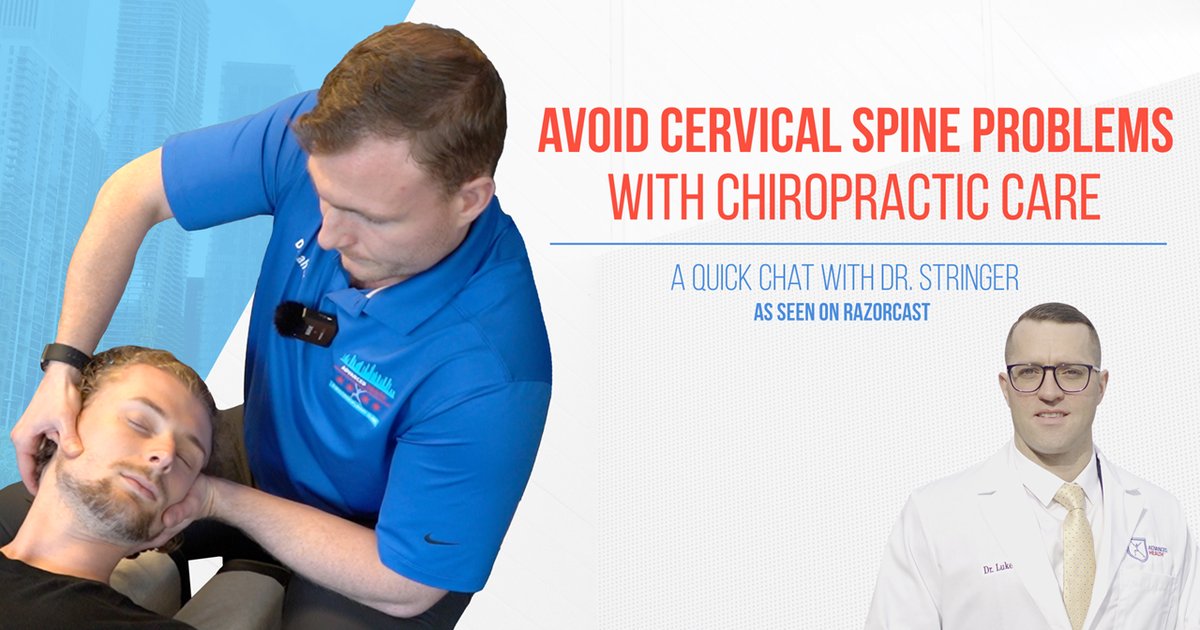
Your cervical spine — the curve in your neck — does more than hold up your head. It houses nerves that control your eyes, ears, sleep, metabolism, and breathing. When posture breaks down, so does how you feel and function. This post walks you through why neck alignment matters, what tech neck actually does to your spine, and how we correct it in our South Loop office.
Why your neck is the "curve of life"
Every nerve in your neck controls a body function you rely on:
- C1 and C2 (the top two cervical bones) feed your eyes, ears, nose, and throat.
- The mid-cervicals innervate your thyroid and diaphragm — meaning they influence sleep, mood, energy, metabolism, and breathing.
- The lower cervicals run your arms and hands.
A healthy neck has a 42-degree backward curve, with the top vertebra stacked over the bottom one. That curve carries the weight of your head on bone, not on the discs and nerves. Lose the curve and you start loading the wrong structures.
What poor neck alignment actually causes
When the cervical spine is stressed and misaligned, you don't just get neck pain. You get a cascade:
- Headaches and migraines
- Neck and upper back pain
- Poor sleep, low energy, irritability, fatigue
- Difficulty managing weight
- Low libido
That's the nervous system telling you it's under load. The sensory and motor nerves running through your neck don't fire cleanly when the bones above them are out of position.
Tech neck and forward head posture
Your head weighs 10 to 12 pounds. Every time you look down at a phone or tablet, that weight pulls you into flexion. The top vertebra creeps forward over the bottom one — what we call anterior head carriage, or forward head posture.
For every inch your head shifts forward, the effective weight on your neck doubles. Over years, that breaks the cervical spine down.
If you're a corporate athlete sitting at a desk all day, ergonomics matter. Your ear should sit directly over your shoulder. Two warning signs in the mirror:
- Your head drifts forward of your shoulders.
- Your shoulders round inward and your traps stay tight.
Those are the telltale signs of upper crossed syndrome — classic corporate America posture. It pulls on the suboccipital muscles at the base of your skull (the ones that rotate your head), which is where cervicogenic headaches come from.
A simple rule of thumb
Whenever you're on your phone, tablet, or laptop, you should be able to fit your whole hand between your chin and the divot at the top of your sternum (the manubrium). That's the maximum flexion you want — whether you're driving, flying, walking, or scrolling. Stay there and you cut tech neck off at the source.
How we correct it at Advanced Health
Fixing a cervical spine isn't a single adjustment. It's a sequence.
1. X-rays first
We take X-rays before we treat. Every cervical spine is different, and we need to see exactly what's going on before we lay hands on it.
2. Spinal adjustments
We find the subluxations — the misaligned, stuck segments — and adjust them. Not every adjustment is the manual "crack" people picture. There are several techniques, and we match the adjustment to your spine.
3. Spinal traction
This is where Chiropractic BioPhysics methods come in. CBP is the most researched form of chiropractic and applies engineering principles to spinal correction. Your X-rays dictate the traction setup. Traction generates heat in the ligaments — the creep effect — which lets your spine stretch incrementally back toward its normal 42-degree curve.
Concerned about your neck, headaches, or tech-neck posture? Get started with our $49 new patient exam and X-rays at Advanced Health in the South Loop. We'll show you exactly what your cervical spine looks like and what it'll take to fix it. Book online at /schedule or call (312) 987-4878.
4. Physical therapy and mobility work
Posture muscles are intrinsic — they respond to movement. When you're pinned to a desk all day, the deep neck flexors and the muscles between your shoulder blades get weak and lazy. The big movers (traps, chest, shoulders) take over and pull you into that forward, rounded shape.
We rebuild the small stabilizers with targeted PT and mobility drills so the correction holds once you leave our office.
What happens if you ignore it
A forward head and a flattened cervical curve increase disc pressure. Increased disc pressure over time means cervical disc degeneration — and that doesn't reverse easily.
There's a systemic cost too. Chronic spinal stress keeps cortisol elevated, and cortisol blocks insulin reception. Glucose stays parked in your bloodstream instead of getting into your cells. That's a setup for metabolic disease, type 2 diabetes, and cardiovascular issues.
As you age, that upper-back rounding turns into kyphosis. The more kyphotic you get, the higher your cardiovascular risk. Posture really is a window to your overall health.
The bottom line
Procrastination is the thief of health. Get your spine moving, get it stable, and address your posture now — not after the discs degenerate. You'll look better, feel better, function better, and live longer for it.
If you're ready to see what your cervical spine actually looks like, book a new patient visit or call us at (312) 987-4878. We're in the South Loop and we'd love to help.
Have a similar concern?
The fastest way to get answers about your specific situation is a New Patient Exam.
Schedule your new patient exam