
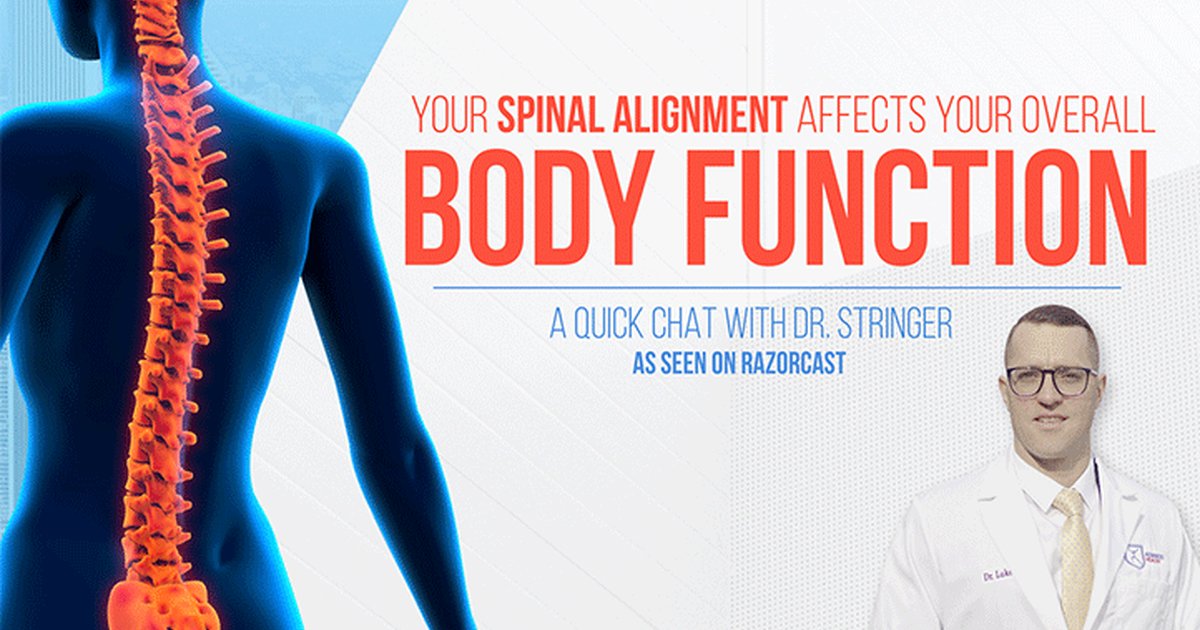
Your spinal alignment shapes how your whole body moves, feels, and functions. When your spine drifts out of position, joints wear unevenly, nerves work under tension, and you start to feel it — in your back, your energy, even your sleep. Here’s what’s actually happening when your spine is out of alignment, why it matters for performance and aging, and how we evaluate it at Advanced Health.
Your spine is the anchor for everything else
More than 80% of your extremities — both tissue and joints — anchor into your spine. Your skeletal system has two parts:
- Axial spine: your neck, upper and mid back, low back, sacrum, tailbone, and pelvis.
- Appendicular skeleton: everything else — shoulders, elbows, hips, knees.
For your shoulders, hips, and knees to align and move well, your spine has to align first. The spine is the foundation; the extremities load off of it.
What happens when the curves are off
You should have roughly a 40-degree curve in your lower back. If that curve is closer to 60 degrees, weight transfers disproportionately into the tailbone and hips. That can create subluxations — misalignments — in the pelvis and sacrum.
Now imagine running with your tailbone and hips out of alignment. Muscles have to work harder to stabilize joints that aren’t tracking properly, which changes how the hip, knee, foot, and ankle get loaded. Repetitive stress on joints that aren’t moving well breaks down the joints and the surrounding tissue. That cascade is how a spinal problem becomes a knee problem, or a foot problem, six months later.
Misalignment keeps your body in chronic stress
Alignment affects more than mechanics. When your spine is out of position, your body sits in a low-grade, chronic stress state. Chronic stress raises cortisol, which can block hormone reception and elevate blood sugar because cells don’t absorb it efficiently. Your homeostasis — the balance your body works hard to maintain — falls out of sync.
The nervous system connection
Your spine houses your nervous system, and your nervous system controls everything you do.
- About 15% of your nervous system is sensory — it transmits pain.
- The other 85% is non-sensory — it regulates the function of organs, glands, and tissues.
If a nerve in your neck is under pressure, the sensory portion might give you neck pain. But the other 85% of that nerve partially innervates the thyroid, which helps regulate sleep, mood, energy, and metabolism. When alignment puts tension on those nerves, you can see the lifestyle complaints we see all the time in our corporate-athlete patients: poor sleep, low energy, brain fog, sluggish metabolism, mood swings.
Neck alignment and performance
A healthy neck has roughly a 42-degree curve, with the top vertebra sitting cleanly over the bottom one. That curve distributes the weight of your head evenly into the joints and soft tissue.
Now picture the top of the neck shifted two inches forward of the base, with 50% of the curve lost — a classic forward-head posture. Research published in Nature has shown that the curve in your neck correlates with how efficiently your spinal cord transmits signals at the synapse.
The practical implication: if you’re a wide receiver tracking a ball, or a surgeon reacting to what’s in front of you, a neck that’s out of alignment processes that stimulus more slowly than a neck that’s aligned. That’s a performance hit you can measure.
Want to know what your spine actually looks like? A new patient exam and X-rays at Advanced Health is $49 — you’ll see your own spinal films and get a clear read on your alignment, curves, and what (if anything) needs to be addressed. Book online at /schedule or call us at (312) 987-4878.
Why earlier is easier
If your spine is out of alignment when you’re young and nothing is done about it, the odds of pain climb steadily as biomechanical stress accumulates in the joints and tissue. Spines that sit out of alignment over time degenerate faster than spines that are aligned.
The younger you are when you address it, the less time and effort correction takes. Wait long enough and the degeneration shows up as pain, stiffness, disc issues, and compensatory patterns you can’t easily unwind.
How we check alignment at Advanced Health
A real alignment evaluation isn’t a guess from looking at you. We take a set of full-spine X-rays — front view and side view — and measure the actual angles of your cervical, thoracic, and lumbar curves against the ideal model. Then we walk you through the films so you can see what we see.
When your spine is aligned, your biomechanics are sound, and there’s no pressure on the nervous system, your body has what it needs to function the way it’s built to. To get evaluated, book a new patient visit or contact our South Loop office.
Have a similar concern?
The fastest way to get answers about your specific situation is a New Patient Exam.
Schedule your new patient exam