
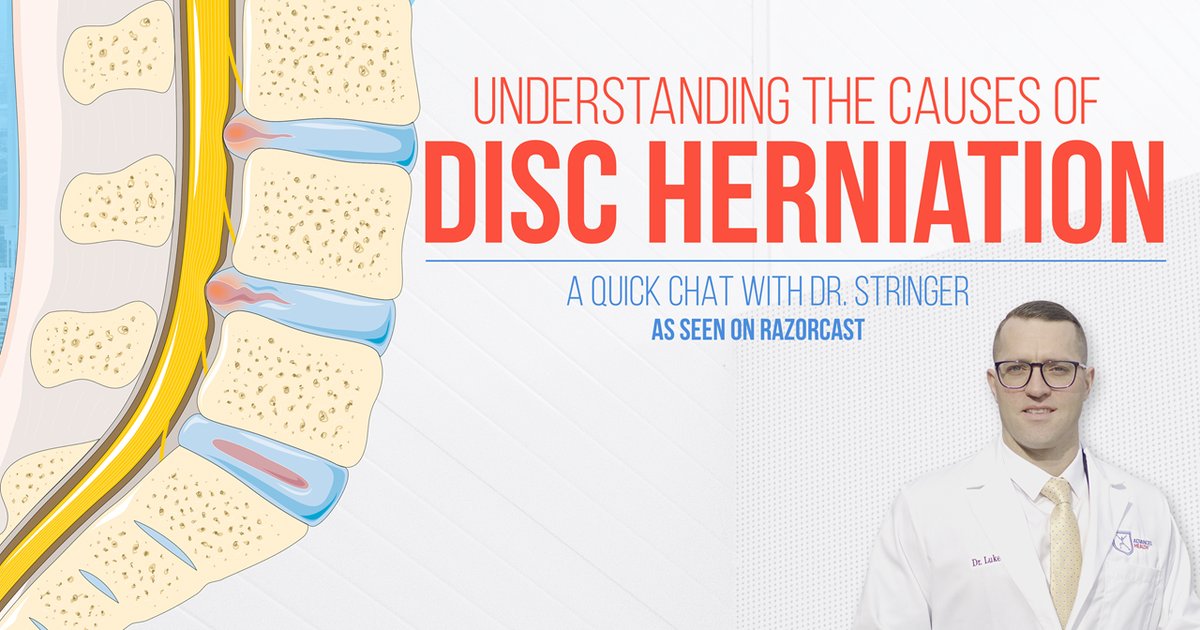
Disc herniations don’t usually come out of nowhere. They’re caused by either a single high-force event (think car accident or a bad lift) or years of repetitive stress from poor posture. In this post, Dr. Luke Stringer explains what a spinal disc actually does, what “herniation” really means, and the everyday habits that quietly break discs down over time — so you can spot the warning signs early.
What a spinal disc is and what “herniated” means
A disc sits between two vertebrae and acts like a shock absorber. Picture a jelly donut: the tough collagen ring on the outside holds in a fluid-filled center. Healthy discs are spongy and full of fluid, which lets your spine flex, rotate, and absorb force — whether that’s gravity pressing down while you sit or impact traveling up your legs when you run.
Discs also keep enough space between the vertebrae for nerves to exit the spinal canal cleanly. That spacing matters.
When a disc is under pressure — often from poor alignment — it loses height and starts to bulge, pushing into the nerve canal. A herniation is the next step: the outer collagen ring cracks, and fluid from the center shifts out, often into the nerve canal itself.
From there, severity is a spectrum. Bulges and small herniations are on the milder end. A full dissection or prolapse — where the disc is completely compromised — is the severe end, and often requires surgery. The less herniation you have, the better.
Trauma and excessive strain
Trauma is the obvious cause. If you’re rear-ended at 50 mph at a stop sign, that force has to go somewhere, and the spine absorbs most of it. Muscles, ligaments, and tendons all take damage, and the discs can absolutely herniate, dissect, or prolapse from a single impact like that.
If you’ve been in a car accident, our auto accident care page walks through what to look for.
Strain doesn’t have to be that dramatic, though. A single bad lift — wrong form, too much weight — can damage a disc in one motion. More often, the damage is repetitive: poor neck posture, head drifting forward of your chest, lost cervical curve. Day after day, that puts too much pressure on the front of the disc, and over months and years it breaks the joint down.
Does aging cause herniated discs?
We all degenerate over a lifetime, but how fast is largely up to us.
If your spine stays in alignment and the joints move well, the discs stay stimulated. Movement is how a disc draws fluid back in through osmosis. So aging alone is not a reason your discs should herniate.
What does change with age: disc fluid gradually dissipates, the discs get more brittle, and gravity has had more time to act on the spine. So degenerative changes are normal — but how severe they get depends on alignment, joint function, and trauma history. Aging is a contributor, not a sentence.
Is disc herniation genetic?
I haven’t seen research showing a direct genetic cause of disc herniations. That said, there are genetic conditions — like hypermobility or excess collagen elasticity — that let joints move beyond their normal limits. When a joint moves too much, the disc takes more stress, and that can absolutely raise your risk.
But just because your dad blew out his low back working in a factory for 40 years doesn’t mean you’re destined for the same thing. Alignment, joint function, and your day-to-day loading habits matter far more than family history.
Worried you might have a disc bulge or herniation? Get a $49 new patient exam and X-rays at Advanced Health in Chicago’s South Loop. We’ll look at your alignment, the discs, and the underlying cause — not just the symptom. Book online at /schedule or call (312) 987-4878.
The cause most people overlook: posture
Posture is the window to your spinal health, and it’s the cause patients underestimate most.
Your lower back should have roughly a 40-degree curve. If you’ve been sitting at a desk 40 hours a week for 10 years, that curve often drops to around 20 degrees — half of what it should be. We see this constantly in what I call the corporate athlete.
Here’s why that matters mechanically. The curve in your low back is designed so the back of the joint absorbs most of your load (that’s where the extra bone is built for it). Lose the curve, and the load shifts forward — to the middle and front of the joint, where the disc lives.
Now add a flexed, leaning-forward sitting position to the equation. Research shows pressure inside the disc can increase by up to 300% in that position. Do that for eight hours a day, five days a week, and you have a recipe for bulges, herniations, and accelerated degeneration.
This is where Chiropractic BioPhysics comes in for us — it’s the method we use to restore those spinal curves rather than just chase pain. Rebuild the curve, redistribute the load, and the disc stops getting hammered.
The takeaway
Disc herniation has a few real causes: traumatic force, a single bad strain, repetitive postural stress, and — to a lesser degree — aging and genetic joint conditions. Most of them are within your control. If you have ongoing back or neck pain, numbness, or tingling, don’t wait for it to become a surgical problem.
Learn more about our approach to disc injuries, or schedule a visit and we’ll take a look.
Have a similar concern?
The fastest way to get answers about your specific situation is a New Patient Exam.
Schedule your new patient exam